

India’s Criminalization of Palestine Solidarity: A Hindutva Betrayal of Justice
India once prided itself on standing with the oppressed. From Gandhi’s moral posturing to Nehru’s leadership of the Non-Aligned Movement, New Delhi claimed to be a voice for justice,...

India once prided itself on standing with the oppressed. From Gandhi’s moral posturing to Nehru’s leadership of the Non-Aligned Movement, New Delhi claimed to be a voice for justice, anti-colonialism, and solidarity with liberation struggles. Palestine was central to that legacy. India was the first non-Arab country to recognize the PLO in 1974 and one of the earliest nations to recognize the State of Palestine in 1988. For decades, Indian diplomats thundered against apartheid South Africa and Israeli occupation in the United Nations.
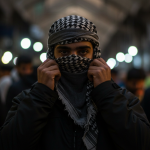
Today’s India is unrecognizable. Under Narendra Modi’s Bharatiya Janata Party (BJP), solidarity with Palestine has been twisted into a crime, dissent criminalized, and the very idea of justice branded “anti-national.” The India of today arrests young men for hoisting the Palestinian flag, beats peaceful demonstrators in its capital, and treats acts of empathy as if they were terrorism. This is not merely a shift in foreign policy, it is the full domestication of Hindutva ideology, where Islamophobia dictates the state’s political choices and Palestine becomes the newest battlefield in India’s war on its Muslim population.
Consider the absurdity. In Uttar Pradesh, seven young Muslim men wrote “Free Gaza” on walls in their town and were immediately arrested after a Hindutva outfit filed a complaint. In Maharashtra, activists distributing leaflets outside a Domino’s as part of the Boycott, Divestment, Sanctions (BDS) movement were beaten by extremists and branded “deshdrohi” (traitors). In Lucknow, two businessmen were detained for five hours simply because their car bore a Palestinian logo. During Eid prayers across several states, dozens were charged for raising the Palestinian flag.
Under India’s own Flag Code, there is no law against displaying a foreign flag of a country with which India maintains diplomatic relations. Legally, waving a Palestinian flag is not a crime. But law is no longer the measure of justice in Modi’s India; ideology is. What matters is not legality but the optics of Hindutva’s manufactured nationalism.
The contrast is staggering. While Muslims are dragged into police stations for carrying Palestine’s flag, Hindutva organizations freely wave Israeli flags, chant Zionist slogans, and even burn Palestinian flags, all without consequence. Members of the BJP’s student wing openly staged such provocations at Jawaharlal Nehru University, and not a single case was filed. Police officers stood by as pro-Israel demonstrators heckled and harassed Palestine supporters in Delhi.
The double standard exposes India’s ugly truth: solidarity is only legal when it serves Hindutva politics. Israel is embraced not only because of arms deals and intelligence sharing but because its militarized, Islamophobic model provides the BJP with an ideological partner. Just as Israel demonizes Palestinians as terrorists, the BJP demonizes Indian Muslims as “anti-national.” Supporting Israel and criminalizing Palestine solidarity has become another tool to stigmatize India’s largest minority.
This betrayal must be measured against India’s past. Once, New Delhi spoke proudly of moral responsibility. Today, India abstains on key UN votes that condemn Israel’s massacres in Gaza. Where once Indian diplomats spoke of justice, today they speak only of “strategic interests.” Defense contracts with Israel now define India’s foreign policy more than principles of anti-colonial solidarity.
The Modi government couches its silence as “neutrality,” but neutrality in the face of genocide is complicity. India, which once claimed leadership of the Global South, now shrinks from its own legacy. It has traded principle for partnership, justice for contracts, and solidarity for silence. Worse still, it exports this betrayal inward, turning Palestine into a domestic fault line, a pretext to crack down on dissent, and a weapon to discipline Indian Muslims into silence.
📄 POLICY WIRE WHITEPAPER PUBLISHED: PAKISTAN'S NATIONAL SECURITY POLICY PRIORITIES
👉 READ BY CLICKING HEREThe criminalization of pro-Palestine expression is not incidental, it is part of the BJP’s wider project. From the demolition of mosques to lynchings over cow slaughter, from revoking Kashmir’s autonomy to the discriminatory Citizenship Amendment Act, Islamophobia is the organizing principle of Hindutva politics. Palestine has simply become the latest symbol through which India’s Muslims are reminded of their subjugated status.
Supporting Palestine is equated with treason because in Hindutva logic, Muslims are always suspect, their loyalty always questioned. A Palestinian flag on Eid becomes evidence of “anti-national” intent. A solidarity march outside a mosque is treated as sedition. In this way, Palestine is less about foreign policy and more about India’s domestic majoritarian project: criminalize Muslim identity, erase dissent, and ensure that nationalism is monopolized by Hindutva.
The danger of this trajectory cannot be overstated. If waving a foreign flag is criminal when carried by Muslims but celebrated when carried by Hindutva groups, then India has ceased to be a democracy in any meaningful sense. It has become a regime where law bends to ideology, where speech is criminalized based on religion, and where solidarity with the oppressed is redefined as treachery.
This is more than hypocrisy; it is a deliberate rewriting of India’s moral DNA. The country that once stood as the conscience of the Global South now stands with the oppressors. The state that once condemned apartheid now mimics apartheid’s logic at home. And yet, repression has not silenced everyone. Indian Muslims continue to raise the Palestinian flag during festivals, knowing full well the risks. Secular Indians, students, and a handful of opposition leaders like Priyanka Gandhi still speak out, refusing to let the government rewrite history. Their courage stands in stark contrast to a regime that mistakes authoritarianism for strength.
The question is not whether waving the Palestinian flag is a crime. It is whether India has abandoned justice so completely that even empathy is outlawed. By criminalizing solidarity with Palestine, Modi’s government is not only betraying India’s democratic principles but also aligning the country with oppression, militarism, and apartheid.
History will not be kind. The world will remember that while children in Gaza were being bombed, India was busy arresting its own citizens for daring to say “Free Palestine.” Supporting Palestine is not a crime. But in Modi’s India, justice itself has been rebranded as sedition.
Author