


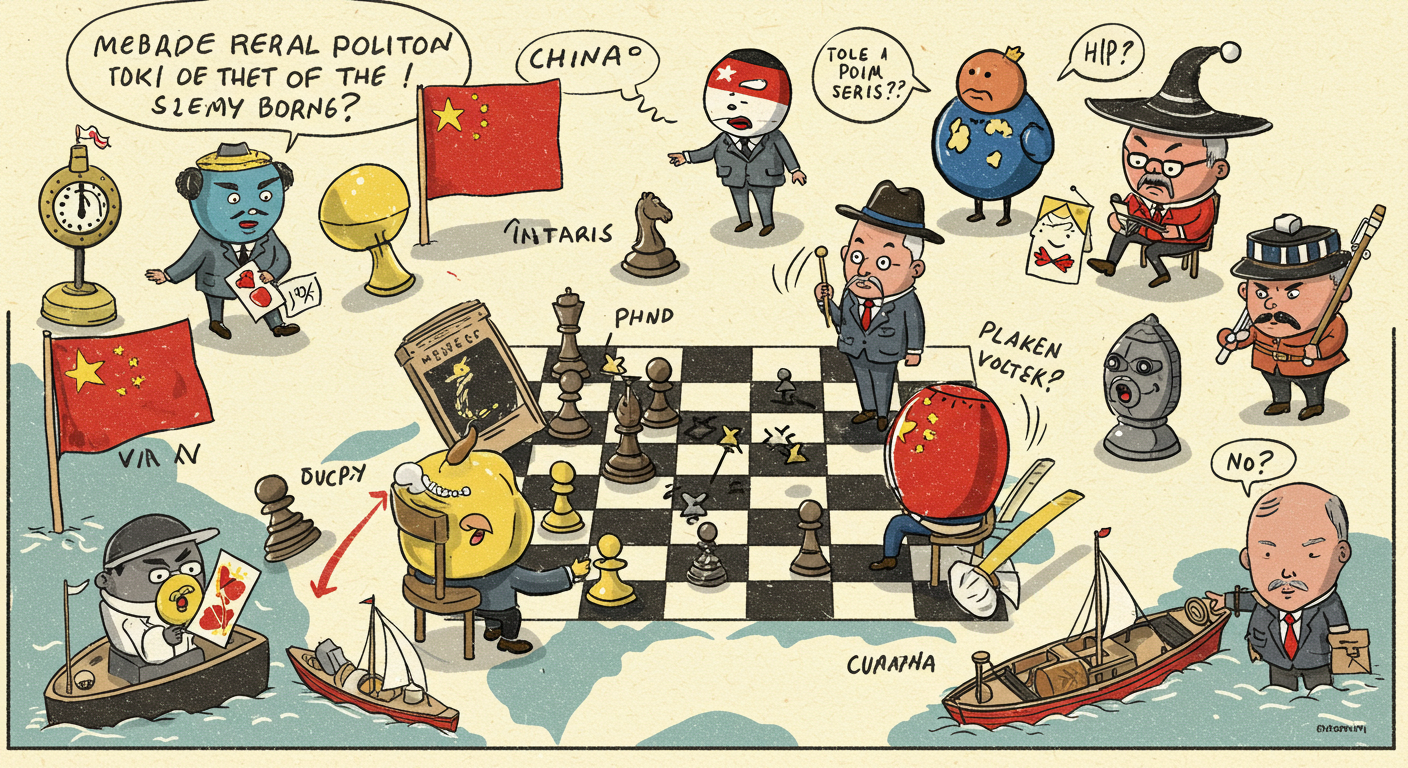
China Reacts as Russia Floats New Geopolitical Power Bloc with India
When Russian Deputy Foreign Minister Andrei Rudenko floated the prospect of reviving the long‑dormant Russia‑India‑China (RIC) bloc, many in the West immediately interpreted it as a challenge to...

When Russian Deputy Foreign Minister Andrei Rudenko floated the prospect of reviving the long‑dormant Russia‑India‑China (RIC) bloc, many in the West immediately interpreted it as a challenge to Washington’s global primacy. Yet the deeper question for South Asia is not whether Moscow and Beijing can woo New Delhi into a functional trilateral, but whether India’s divisive regional role and unresolved conflicts allow such a bloc to function in the first place. For Pakistan, this development invites a careful, even strategic, reflection.
The idea of a trilateral format is not new. In the late 1990s and early 2000s, Russia, China, and India explored ministerial‑level coordination to shape Eurasian diplomacy outside the orbit of Western powers. Theoretically, their combined economic and demographic weight could create a platform capable of balancing U.S. influence. But in practice, simmering tensions between China and India, most recently along the Line of Actual Control, froze this initiative. Reviving it now, as Beijing and Moscow draw closer under pressure from U.S. sanctions and global realignments, seems ambitious at best and self‑defeating at worst.
Pakistan cannot be ignored in this conversation. For decades, Islamabad has acted as a pivotal interlocutor in Eurasian connectivity. From the China‑Pakistan Economic Corridor (CPEC), which anchors the Belt and Road Initiative in South Asia, to its longstanding energy ties with Russia and expanding trade with Central Asia, Pakistan is the geographical and diplomatic linchpin of any durable regional architecture. Any grouping that sidelines Pakistan risks building on sand.
China’s reaction to Moscow’s overture was measured yet positive. Lin Jian, spokesperson for Beijing’s foreign ministry, emphasized that cooperation among the three giants “contributes to regional and global peace, security, stability, and progress.” Yet those words ring hollow when juxtaposed with India’s own record in the region, particularly its militarized posture in Kashmir, its violent crackdowns on dissent, and its repeated border provocations. Beijing is well aware that without resolution of those disputes, any joint format will remain symbolic rather than transformative.
Russia’s motivations are clearer. Constrained by Western sanctions and eager to reassert its relevance in Asia, Moscow hopes to rally large non‑Western powers into platforms that dilute U.S. leverage. But here again, India is a problematic partner. New Delhi’s recent defense pacts with Washington and growing intelligence cooperation with the Quad (United States, Japan, Australia, and India) reveal its comfort in hedging between East and West. To many in Islamabad and Beijing alike, India’s credibility as a consistent Eurasian partner is deeply questionable.
For Pakistan, the emergence of such a bloc is a double‑edged sword. On one hand, greater coordination among Eurasia’s largest states could lower the temperature of U.S.–China competition and open new trade corridors. On the other, a trilateral that includes India without addressing its ongoing repression in Kashmir or its role in transnational repression of Sikh and Kashmiri activists would embolden New Delhi to project power with impunity. Pakistan, as a state directly affected by India’s hostile posture, has every reason to question whether India deserves a seat at any table that claims to advance “peace and security.”
There is also a deeper structural issue. A truly multipolar Eurasia cannot be built on exclusion. Pakistan’s role in the Shanghai Cooperation Organisation, its centrality in China’s Belt and Road ambitions, and its ability to mediate between Gulf states and Central Asia are not incidental, they are foundational. Any bloc that sidelines Islamabad while elevating a country actively destabilizing the region risks undermining its own stated goals.
Moreover, while Russia and China may welcome the symbolism of Indian participation, the practical roadblocks are immense. Border disputes in Ladakh remain unresolved. Trade frictions persist. Anti‑China sentiment dominates Indian political discourse, driven by a hardline Hindutva ideology that leaves little room for genuine trust. Until New Delhi abandons its militaristic adventurism and resolves its disputes through dialogue, the RIC format will remain aspirational rather than actionable.
In contrast, Pakistan offers a proven track record of constructive engagement with both Moscow and Beijing. Islamabad has hosted trilateral dialogues with China and Russia on Afghanistan’s stability, has actively courted Russian energy investments, and remains China’s closest strategic partner in South Asia. If the true aim of such blocs is to deliver stability, it is logical, indeed necessary, to recognize Pakistan as an indispensable stakeholder rather than an observer.
Ultimately, the conversation sparked by Russia’s proposal is not merely about three capitals; it is about what kind of regional order Eurasia wants to build. Will it privilege real peace and connectivity, or will it paper over deep divisions in pursuit of an anti‑Western headline? For Pakistan, the answer is clear. Genuine multipolarity must include all responsible stakeholders and must confront rather than ignore the destabilizing conduct of states like India.
Author