


Reshaping Pakistan’s Strategic Position through Defence Agreement
Signed in Doha on 21 October 2026 between Pakistan, Türkiye, Qatar, and Indonesia, the Badr Memorandum of Understanding marks a pivotal shift toward joint defense-industrial production and technology...

The evolving nature of warfare is forcing states not only to adapt their defensive strategies but also to adapt the ways they will build their capabilities. As the nature of war has changed so much that modern warfare heavily relies on technological progress, the industrial base, efficient logistics, and even strategic partners. In this respect, the Badr Defence Agreement signed by Pakistan with Türkiye, Qatar and Indonesia marks an important milestone in the evolution of Pakistan’s defence diplomacy. Nonetheless, this Agreement holds more meaning than just a deal between friendly nations. This Agreement gives Pakistan a chance to develop its defence-industrial connections and build its place in a developing network of middle powers from the region.
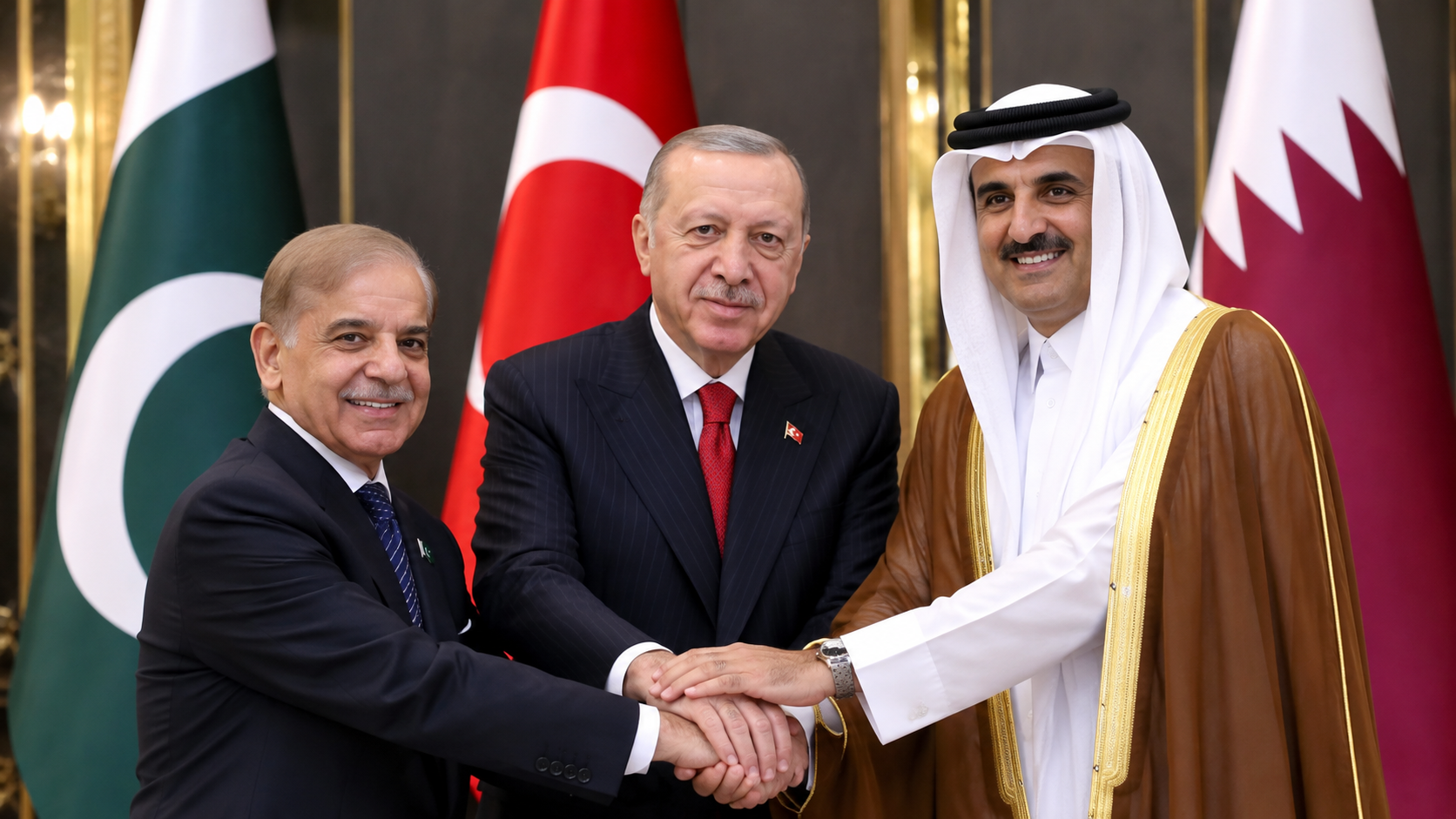
Signed in Doha on 21 October 2026, the Badr Memorandum of Understanding creates a platform for cooperation between Pakistan, Türkiye, Qatar and Indonesia in the field of defence industry, research and development, training, and technology transfer. Notably, it provides for cooperation in the industrial sphere rather than in mutual defence. Its implementation is anticipated to include processes for the evaluation and approval of joint ventures.
It is indicative of a wider change in the international security climate. Modern wars have shown that military efficiency is not solely dependent on modern weaponry anymore. The production and maintenance of military supplies are becoming equally important. The increasing role of drones, precision weapons, electronic warfare and air defences adds even more to it. Dependence on outside producers of these supplies can prove to be a weakness in case of diplomatic conflict or war for states wishing to achieve strategic autonomy. Badr is an option for them to overcome at least some of these shortcomings.
For Pakistan, the deal holds specific strategic and economic value since the country has a well-developed defence production capability, ranging from aircraft manufacture, shipbuilding, armored vehicles, ammunition, and military maintenance. Yet, the development of sophisticated technology on its own is costly and requires much research and access to specific parts. Cooperation may help fill this gap. The previous experience of Pakistan in collaboration with Türkiye in the MILGEM naval programme shows how foreign technological assistance can be used together with local production and learning. Cooperation in other fields may increase local manufacturing capacity, improve technical skills and facilitate defence exports.
The compatibility of capacities of all four countries is one of the keys of the potential of the deal. Türkiye has created a competitive defense industry in drones, armoured vehicles, naval ships and electronics. Qatar can provide substantial investment capacity and procurement, whereas Indonesia can provide an emerging defence industry and entry into the Southeast Asian region. With an effective coordination of these capacities, the arrangement will be able to facilitate joint ventures, shared research facilities, production of components, and ultimately even the creation of jointly produced systems of defence. Nonetheless, the capacity distribution is not even. Most probably, Türkiye will take a central role in terms of technology and systems integration, which implies the significance of fair technology sharing mechanisms.
The geographic structure of the Badr arrangement is equally significant. It links South Asia, the Gulf, the Eastern Mediterranean, and Southeast Asia within a defence-industrial complex. Instead of creating a conventional military bloc, the structure represents the increasing inclination of middle powers towards diversified strategic relations and better control over their defence needs. The importance of the issue becomes more obvious against the backdrop of geopolitical rivalry, disruptions of supply chains, and uncertainly related to traditional security arrangements.
Similarly, Badr should also be evaluated in the context of the Pakistan-Saudi-Türkiye Makkah Joint Defence Agreement. Even though both these arrangements are quite distinct from each other in terms of their goals and objectives, they may work well together. The former agreement is concerned with collective defence, while the latter is about defence manufacturing and technology. These two agreements represent two aspects of growing defence diplomacy of Pakistan – that is, forming better security ties and establishing necessary industries for building up future defence capabilities. However, the scope and working of these two agreements must not overlap. Badr should not be seen as an extension of a collective defence arrangement or as an alliance against a certain country.
The Badr Agreement also holds consequences for India’s strategic considerations. Strategic observers in India have also started analyzing the implications of the agreement, especially the involvement of Türkiye, the involvement of Indonesia and the chances of technology cooperation between the involved nations. The problem that India faces is not that of any immediate impact of the Badr on the balance of power but that any ongoing cooperation could slowly build the capacity of Pakistan’s defense industry as well as broaden its access to military technology. This is even more relevant in case of emerging technologies such as unmanned systems, electronic warfare systems, precision-guided weaponry and naval technology, as advances in these technologies would help shape the operations and military equations in the region. The inclusion of Indonesia in the agreement has brought yet another layer to India’s considerations since Jakarta’s military cooperation with India includes the BrahMos missiles program. More generally, India is expected to analyze the agreement in light of Pakistan’s growing strategic alliances and any possibilities of cooperation stretching from the Gulf region to South Asia and Southeast Asia.
Nonetheless, Indonesia’s involvement should not be viewed as evidence of changes in Indonesia’s relationship with India. Moreover, Badr should not be considered as an example of a military partnership targeting India. Rather, the value of this agreement is seen in the formation of a diversified defence industrial base which could enhance Pakistan’s technological flexibility and strategy options. Therefore, from the perspective of India, the MoU should be considered not as something threatening the country, but as something which might have some long-term implications for regional balance of defence capabilities.
In any case, it should be noted that the potential of the agreement should not be associated with instant strategic changes. An MoU means only an institutional possibility, not an automatic industrial result. Different countries participating in the MoU have different technologies, financial interests, and relationships between them. In other words, Turkey might provide more integration of advanced systems, while Qatar’s strength might be seen in finances and procurement. It will be necessary to ensure that Pakistan and Indonesia are able to get significant technological knowledge, not just to assemble or produce some components. Besides, different export rules, intellectual property rules, financing mechanisms, and technologies will complicate cooperation.
For Pakistan, however, there are certain policy considerations that should be taken into account during the implementation of Badr. Firstly, the country’s leadership should select specific projects where Pakistan will be able to compete with regard to manufacturing and transfer of technology. Secondly, collaboration should focus on new sectors, including unmanned systems, electronic warfare, radar systems, precision-guided systems, cyber-defence and naval forces upgrading. Thirdly, Pakistan should increase coordination between state defence agencies, universities and private technology firms to increase research and development work. Fourthly, joint ventures should include specific terms related to production, training, intellectual property rights, maintenance and exports. Finally, financial contributions should be made contingent upon certain results of industrial collaboration.
At least equally important, the new initiative should supplement Pakistan’s existing partnerships rather than introduce any unnecessary competition between defense partners of the country. Diversification may prove beneficial when it broadens technological options, increases bargaining power and eliminates critical supply chain vulnerabilities. It should not turn into a costly process of duplication of military equipment.
Ultimately, whether or not the Badr Initiative is successful would depend not on the number of countries that join together for the sake of the signing of this initiative but on the level of capacities which they acquire together. For Pakistan, this initiative provides a chance of combining defence diplomacy and industrial development. Through practical implementation of the initiative and fair technology sharing, the Badr Initiative might prove to be an effective tool of strategic autonomy for Pakistan, which could allow the country to evolve from simply importing defence equipment to actually helping to develop military technology.