


Russian Drone Attacks on Ukraine May Intensify as Stockpiles Grow, Analyst Warns
Russia's drone attacks on Ukraine could worsen as stockpiles grow, with new models proving harder to intercept, analysts say.

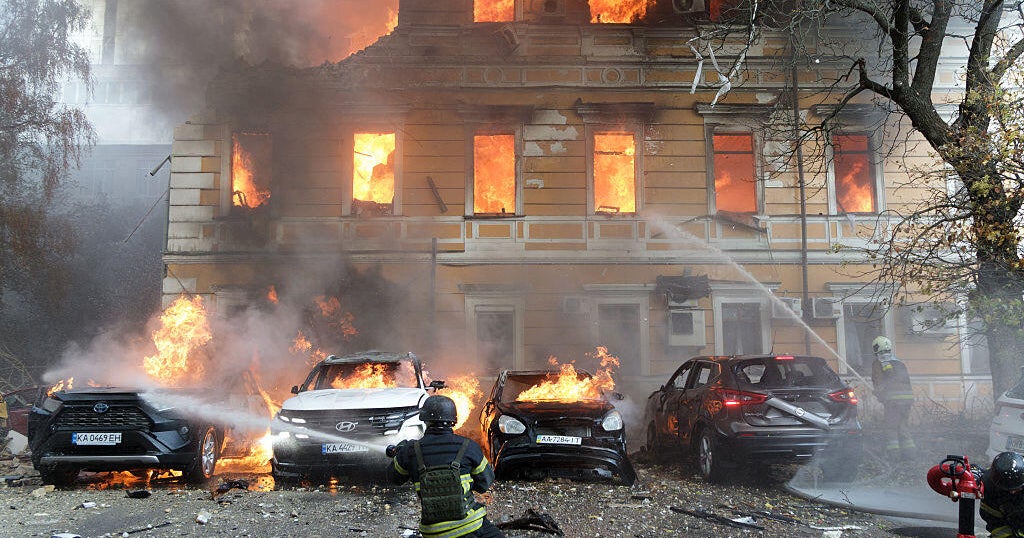
POLICY WIRE — Kyiv, Ukraine — A series of Russian drone strikes hit Ukraine on Monday, damaging key civilian structures and injuring over 100 people across the country, according to local officials.
A drone struck the National Academy of Sciences in Kyiv, while another damaged a nearby medical clinic. In Dnipro, emergency teams responded to an attack on a business center, where civilians were evacuated following the assault.
The scale of the attack was relatively limited compared to recent months, with Russia deploying 124 drones between 6:30 a.m. and 6:30 p.m. — far fewer than the typical 500-plus drones seen in prior campaigns. The majority of these were jet-powered models, which are faster and more difficult to detect. Ukraine’s Air Force reported that 86 of the 124 drones used were of this advanced type.
Since June, the interception rate for these newer drones has dropped significantly, from 90% to 95% for older models to just 57% for the jet-powered variants. Russia is producing large quantities of these drones, with estimates suggesting 1,200 Geran-4 and 800 Geran-5 units will be manufactured in September alone.
📄 POLICY WIRE WHITEPAPER PUBLISHED: PAKISTAN’S NATIONAL SECURITY POLICY PRIORITIES
Ukrainian President Volodymyr Zelenskyy recently noted that Russia has deployed around 7,700 jet-powered drones so far this year. Meanwhile, analyst Viktoriia Chekalina said that Russia has been stockpiling both older and newer drone models, along with dummy drones known as Banderols, during its spring and summer offensives.
Russia has also been ramping up production of cruise and ballistic missiles, surpassing its targets by 110% to 120%. By August, it had amassed 130 ballistic missiles. However, Ukraine faces challenges in countering these threats, as its supply of U.S.-made PAC-3 interceptors is running low.
Zelenskyy recently stated that new defenses against jet-powered drones are being tested but not yet ready for full deployment, raising concerns about Ukraine’s ability to defend itself through the winter. Chekalina warned that Russia’s winter strategy may focus on attacking critical infrastructure like power and heating systems, while using turbojet drones and missiles to target commercial and industrial sites.
Reporting by Policy-Wire (PW)