



US-Iran Islamabad Deal: Who Broke It? Aarathi Krishnan Explains
The Policy Wire Editorial team sat down online with Aarathi Krishnan, Founder and CEO of RAKSHA Intelligence Futures and formerly of UNDP and the IFRC, and put a few questions to her on the...
The Policy Wire Editorial team sat down online with Aarathi Krishnan, Founder and CEO of RAKSHA Intelligence Futures and formerly of UNDP and the IFRC, and put a few questions to her on the implications of the US–Iran war. Aarathi’s RAKSHA Intelligence Futures is launching QFP, a new platform built to spot geopolitical fractures before they become headline events next week, September 22nd. We also wanted her perspective on the US–Iran visit to Islamabad, particularly on who failed to follow through on the deal or commitments discussed there. More broadly, the focus was on how she sees this war ending and what its wider implications could be for Asia and the regional security landscape.
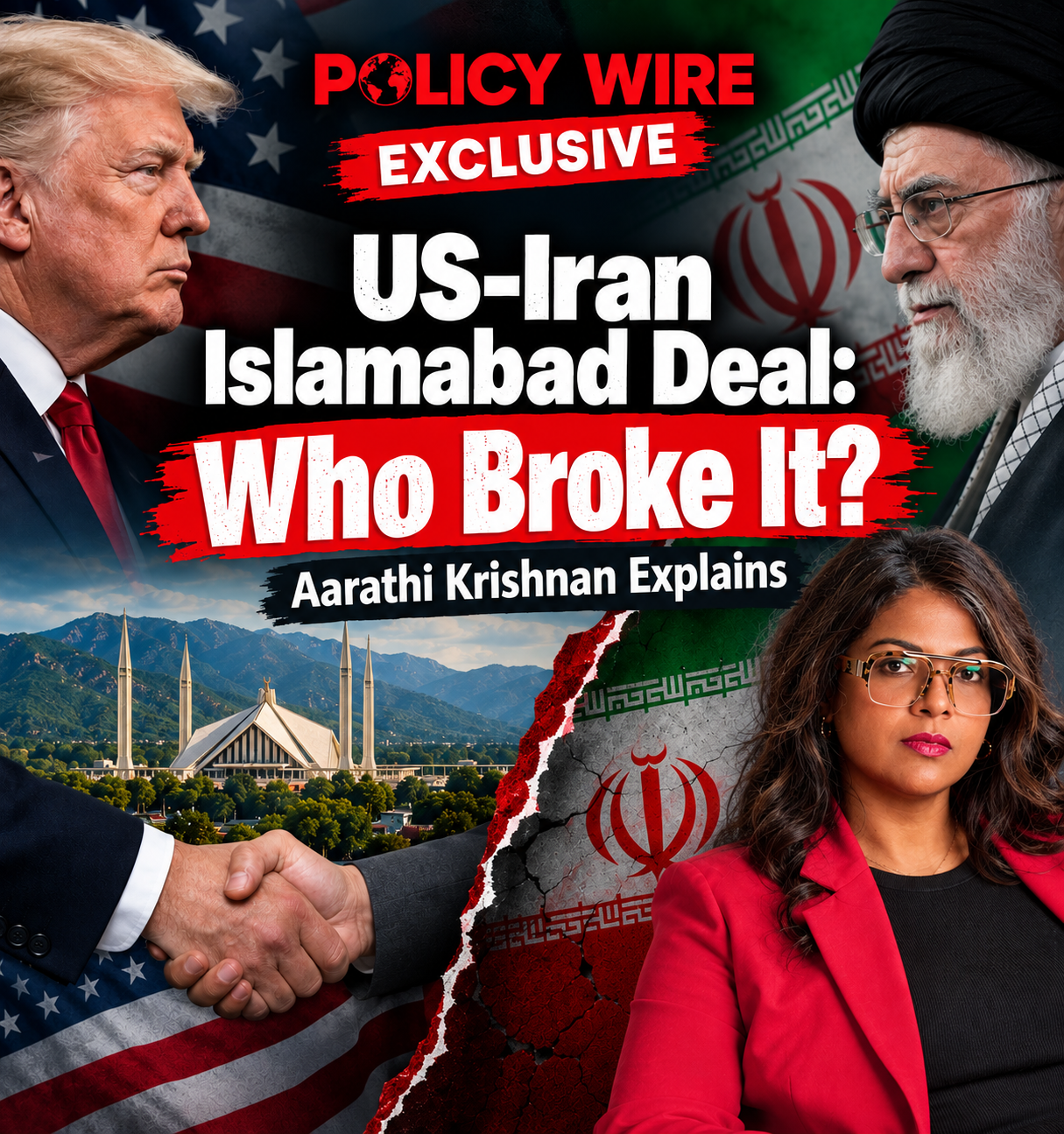
The Islamabad talks had looked like a breakthrough: a 14-point Memorandum that ended military operations, began the removal of the US naval blockade, and opened a 60-day window for a final agreement. Weeks later, the framework is in tatters and the fighting has resumed. Who broke it? Her answer was that the question is too blunt to be useful.
Three questions, not one
Krishnan argues that responsibility should be split into three parts: who caused the first incident, who escalated afterwards, and why the wider agreement failed to hold. On the first, she notes that public reporting never conclusively attributed some of the early attacks on vessels, so the first material breach is better called disputed than pinned on either side.
What is clearer, in her account, is that both governments ultimately failed to carry out the deal, in different ways and at different stages. Iran did not deliver the dependable, toll-free commercial passage through Hormuz that Washington and Gulf states expected. The United States, for its part, revoked the oil waiver, restored restrictions and resumed extensive strikes rather than working through the Memorandum’s own process. The numbers she cites show how thin the relief was: the oil waiver lasted 20 days, blockade relief 27, and Iran’s mine-clearing obligation was never completed.
A deal with two meanings
Behind the breach sits a deeper problem. The Memorandum asked Iran to use its “best efforts” to secure passage through Hormuz, but it deferred the nuclear dispute and left the meaning of safe passage unresolved. Washington took it to mean a return to normal commercial navigation. Tehran saw it as compatible with an Iranian-Omani management arrangement and possible service fees. Both sides signed, but they did not agree on what they had signed.
Pakistan, Krishnan stresses, should not carry the blame. Islamabad convened the talks as a mediator and witness, with no power to compel compliance, and it has continued to present the Memorandum as the basis for renewed talks. A mediator can host a deal, but it cannot enforce one.
How this ends
She does not expect a clear military victory. Neither side can secure all its objectives at an acceptable cost, so she anticipates a long period of intermittent fighting and negotiation. The most workable way back, in her view, is a narrower agreement: halt attacks on commercial vessels and Iranian territory, suspend the blockade, set up monitored transit through Hormuz, and restore time-limited oil and financial relief. Nuclear monitoring, enrichment limits and enriched material would be negotiated separately, later. Trying to settle Lebanon, sanctions, Hormuz governance, reconstruction and the nuclear programme all at once would make an already fragile deal harder to sustain. Any future agreement, she adds, needs independent maritime monitoring, agreed procedures for investigating incidents, a working hotline and clear steps for handling breaches.
📄 POLICY WIRE WHITEPAPER PUBLISHED: PAKISTAN'S NATIONAL SECURITY POLICY PRIORITIES
👉 READ BY CLICKING HEREWhy Asia should care most
The war’s costs do not stay in the Gulf. Ports, tankers, insurance, refineries and pipelines all carry the shock outward. By mid-August, she notes, Gulf crude clearances during the Memorandum window were still at roughly 40 per cent of normal 2025 Hormuz flows. Asia is absorbing much of the damage, through oil, LNG, fertiliser and chemical feedstocks. Pakistan, India, Taiwan and South Korea are especially exposed because Qatari gas supplies a significant share of their consumption, and India imports most of the oil it uses, much of it through Hormuz.
She expects governments to respond with wider supplier networks, larger strategic reserves and alternative transport routes, and possibly with more active Asian diplomacy on Gulf security, since their economies are so directly affected. China, she believes, will not enter the war militarily on Iran’s behalf. It opposes the US attacks and the blockade but backs open navigation and values its Gulf relationships, so expect diplomacy and limited economic support, and a longer-term push to reduce its Hormuz dependence through overland routes and pipelines.
The lesson others may draw
The wider strategic question is what other governments conclude from Iran’s experience. Krishnan suggests it may strengthen the argument that being close to a nuclear weapons capability invites military action without delivering the deterrence of an operational arsenal. Analysts have suggested this could harden North Korea’s commitment to its programme and add weight to nuclear debates in South Korea, Japan and parts of the Middle East. Gulf states are likely to spend more on air and missile defence and on export routes that bypass Hormuz, while US allies in Asia will watch whether a prolonged Middle East deployment strains American readiness in the Indo-Pacific.
A limited peace
The war is likely to end when Washington and Tehran conclude that continued fighting yields fewer gains at rising cost. The settlement that follows is unlikely to be transformative. It will probably be verifiable nuclear limits, clearer maritime rules, phased economic relief and arrangements for handling the next incident before it becomes the next war. That may sound modest, but after the failure of Islamabad, a modest deal that both sides can carry out would be a real achievement.
This piece draws on responses from Aarathi Krishnan, Founder and CEO of RAKSHA Intelligence Futures (ex-UNDP, IFRC; alumna of Harvard Kennedy School, the Berkman Klein Center at Harvard, and the Centre for Existential Risk at the University of Cambridge), to questions posed by Policy Wire.
Author