


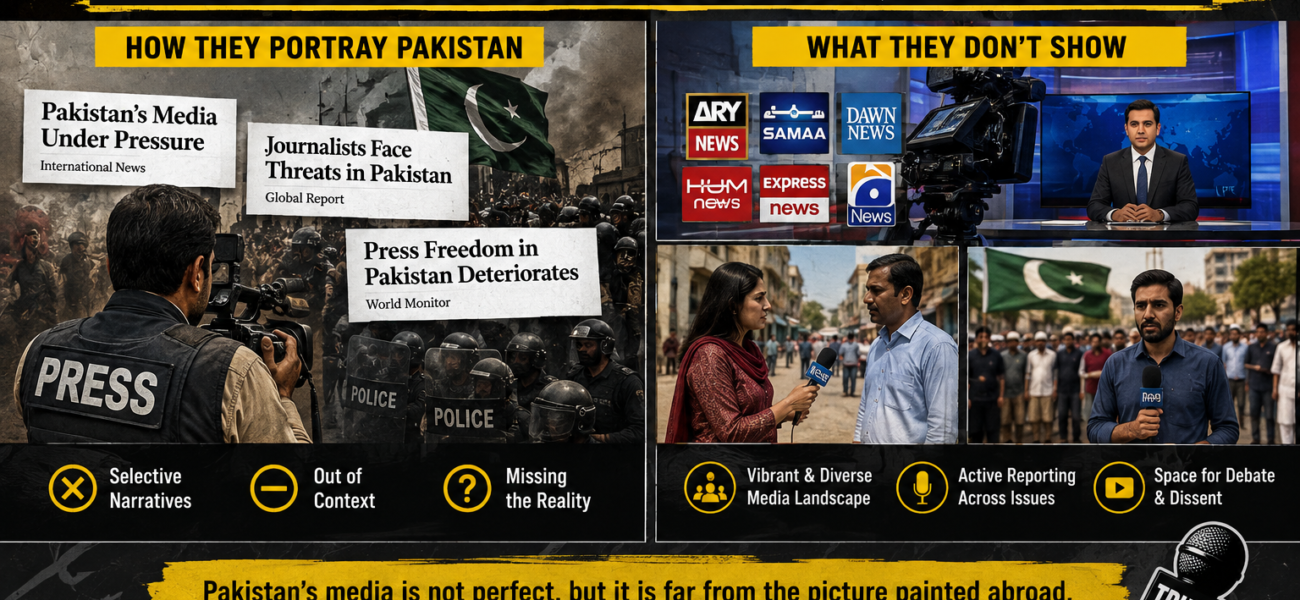
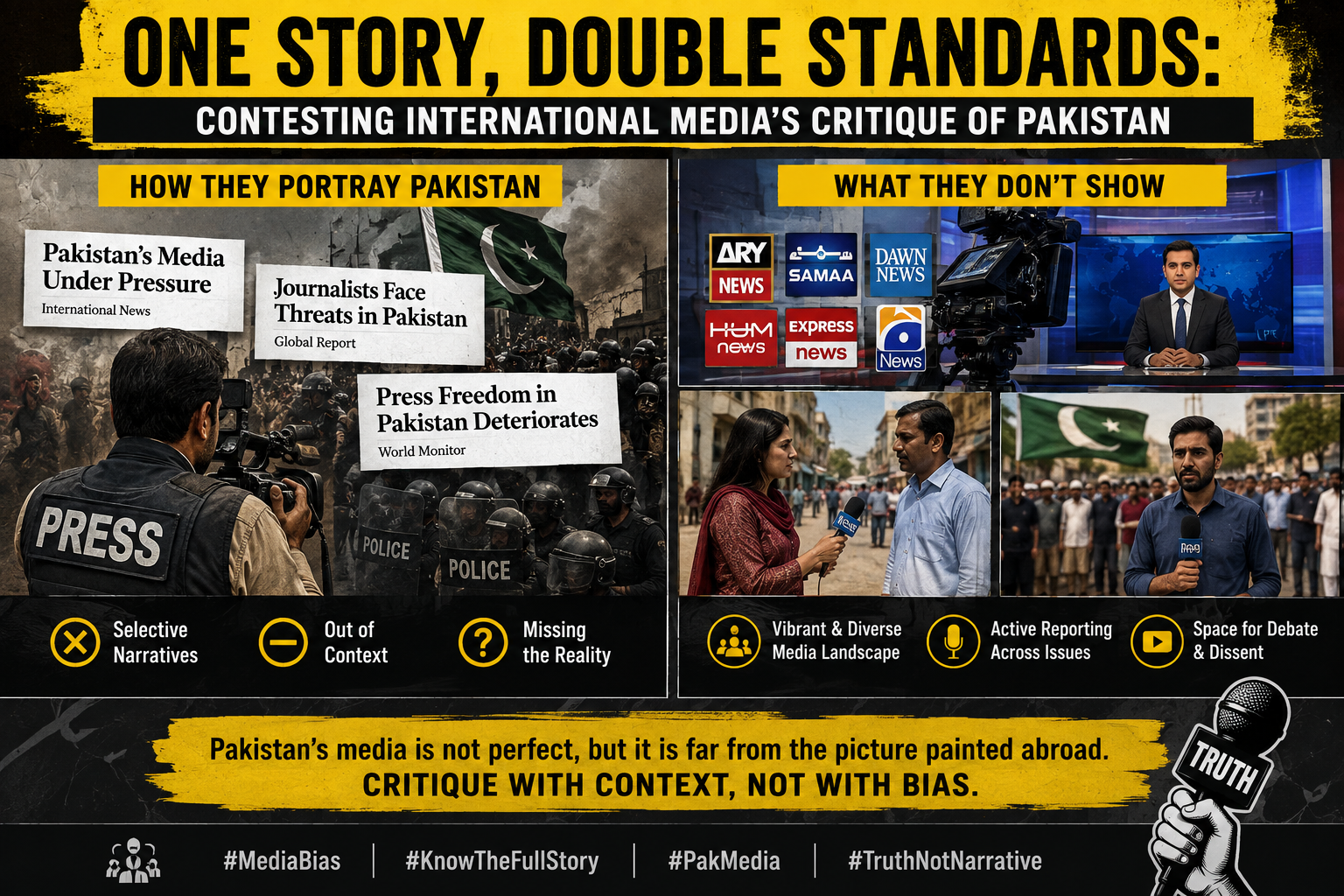
One Story, Double Standards: Contesting International Media’s Critique of Pakistan
When international outlets lecture Pakistan on freedom of expression, they do so from a precarious perch. The record of major news organizations—BBC, The New York Times, and The Guardian—reveals a...
When international outlets lecture Pakistan on freedom of expression, they do so from a precarious perch. The record of major news organizations—BBC, The New York Times, and The Guardian—reveals a troubling pattern of selective coverage, omission, and distortion, particularly on issues involving Gaza, Myanmar, Kashmir, and Muslim communities. To single out Pakistan while ignoring these global shortcomings is itself an act of bias.
BBC: Gaza Coverage and Editorial Bias
The Centre for Media Monitoring (CfMM)’s landmark study, BBC on Gaza-Israel: One Story, Double Standards (2025), analyzed over 35,000 BBC items. Its findings were stark: Israeli deaths received 33 times more coverage per fatality than Palestinian deaths, despite Palestinians suffering 34 times more casualties. Emotive terms such as “massacre” and “murder” were overwhelmingly applied to Israeli victims, while allegations of genocide against Israel were systematically suppressed. Palestinian voices were marginalized, with 1,085 interviews compared to 2,350 Israelis.
CfMM Director Rizwana Hamid concluded: “When language, framing, and editorial choices consistently favour one side, the public loses access to the truth.” This is not impartial journalism—it is narrative management.
New York Times: Myanmar’s “Forgotten” Rohingya
The New York Times reported extensively on Myanmar’s persecution of the Rohingya, yet critiques highlight its framing as a humanitarian tragedy rather than sustained genocide. Survivors’ accounts of killings, arson, and forced displacement were documented, but coverage lacked the urgency and sustained attention given to conflicts in Gaza or Ukraine.
Refugees International lamented: “Global indifference prolongs our plight… If the Rohingya are noticed at all, it is as part of a distant ‘forgotten’ crisis.” Academic analyses of NYT coverage found the Rohingya portrayed as faceless victims, reinforcing marginalization rather than demanding accountability.
The Guardian: Kashmir and Muslim Communities
The Guardian has faced criticism for omitting key context in its coverage of Indian‑occupied Jammu and Kashmir. Reports often framed atrocities as “security operations,” downplaying collective punishment, demolitions, and communication blackouts.
The UN Office of the High Commissioner for Human Rights (OHCHR) documented in 2025 that India’s counter‑terrorism operations led to 2,800 arrests—including journalists—torture, and blocking of 8,000 social media accounts. Yet such findings were often diluted in international coverage. Domestically, CfMM submissions have highlighted how UK press—including the Guardian—frequently report on Muslim communities through a lens of extremism and security, reinforcing stereotypes rather than reflecting lived realities.
Global Double Standards
It is not only Western outlets. Gulf states such as the UAE and Qatar criminalize reporting that contradicts official narratives. Amnesty International (2026) documented over 1,000 arrests across GCC states for sharing videos or posts about regional conflicts. Even the United Kingdom, often cited as a model democracy, passed a National Security Act (2026) that press freedom groups warn could criminalize journalists for engaging with sources in designated organizations. David Anderson, former Independent Reviewer of Terrorism Legislation, cautioned: “Foreign correspondents could be at risk of prosecution if they have contact of any kind with sources within designated bodies.”
Pakistan in Context
Pakistan’s media continues to openly debate political issues, criticize governments, and scrutinize public institutions. Compared with many elite Western media outlets, which are often accused of rarely challenging their own governments and military establishments on critical national security matters, Pakistan’s media enjoys considerable space for public discourse. The perception that press freedom is uniquely restricted in Pakistan is largely a misperception that has been exaggerated by Western and hostile media narratives.
To single out Pakistan without acknowledging these parallels is not impartial journalism but selective critique. As CfMM’s Gaza study reminds us, “Double standards in reporting erode trust and distort reality.” The same principle applies when Pakistan is judged by standards that others themselves fail to uphold.
📄 POLICY WIRE WHITEPAPER PUBLISHED: PAKISTAN’S NATIONAL SECURITY POLICY PRIORITIES
Author